
 English
 Tiếng Việt
 Long-lived confidentiality
Information collected today may remain valuable long enough for future cryptanalytic advances to matter.
FIPS 140-3 LEVEL 3 VALIDATED HARDWARE · NIST CMVP #5331
Mobile-ID brings together cryptographic discovery, validated hardware, providers and SDKs, PKI, remote signing, data protection, verification and managed crypto-agility for a controlled transition from RSA/ECC to hybrid and PQC target states.
Certificate #5331 validates the listed hardware and firmware module plus the approved services in its NIST Security Policy. PQC capability and algorithm-validation status are disclosed separately.
NAMED PRODUCTS
Discover cryptographic exposure from packet captures, certificates, software dependencies and declared CBOM data—then turn findings into an owned migration backlog.
Explore → Controlled pilotAugment existing PDF, CMS, XML and software artifacts with versioned quantum-safe evidence while preserving the original business object and verification history.
Explore → Research / partner pilotPresent QKD-derived keys through governed enterprise interfaces, synchronize approved key material with HSM/KMS controls and support PPK-based protected tunnels.
Explore → Research previewBuild and execute small quantum circuits in the browser, inspect amplitudes and probabilities, and connect quantum-computing concepts to PQC migration decisions.
Explore → Controlled pilotProtect selected fields, files, messages and API payloads before they cross shared infrastructure, using versioned hybrid/PQC envelope profiles and protected backend key services.
Explore → Solution previewSupport auditors in validating wallet formats, challenge signatures, activity evidence, counterparty exposure and proof-of-control records across approved blockchain connectors.
Explore → Research labModel the impact of post-quantum signatures on wallets, transactions, smart contracts, consensus interfaces and verification costs before committing to a chain migration design.
Explore → Pilot platformDesign, issue, validate and migrate classical, hybrid and PQC certificate profiles across CA, RA, VA, TSA, HSM and relying-party ecosystems.
Explore →WHY ACT NOW
Long-lived confidentiality, signatures and trust services depend on cryptography embedded across infrastructure, policy, software and operational evidence.
Information collected today may remain valuable long enough for future cryptanalytic advances to matter.
Contracts, certificates and legal evidence must remain verifiable across algorithm and certificate lifecycles.
Public-key cryptography is embedded in CA, HSM, middleware, APIs, applications, devices and operational procedures.
Algorithm changes require policy, interoperability testing, version control, monitoring and an evidence trail.
QUANTUMSAFE PRODUCT ECOSYSTEM
Seven product pillars connect visibility, protected keys, application integration, trust services, data protection, verification and continuous crypto-agility. Every capability is labeled by evidence-backed maturity.
Build cryptographic visibility, prioritize quantum risk and govern migration with evidence.
Protect keys in validated hardware and governed enterprise key-management architectures.
Expose controlled cryptographic capabilities to Windows, Java, native, web and mobile applications.
Transform CA, RA, VA, TSA, signing and evidence services as one governed trust lifecycle.
Protect authenticity, integrity and long-lived confidentiality across documents, APIs, networks and archives.
Prove what works, for which version, under which scope—and keep that evidence current.
Equip executives, architects and developers with the knowledge and test assets required for responsible adoption.
TRUSTED KEY TOKEN
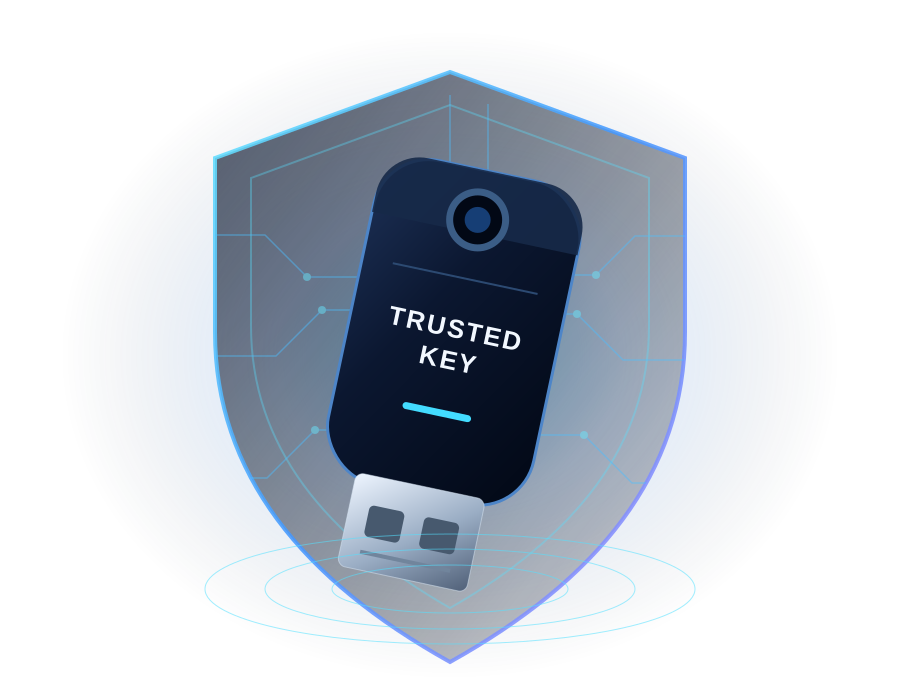
The Trusted Key Token is a portable smart-card-based cryptographic module designed for strong authentication, digital signatures, secure online transactions and protection of sensitive data.
Designed for controlled deployment
The NIST record covers the identified module configurations and approved cryptographic services listed in the public Security Policy.
ML-KEM (FIPS 203), ML-DSA (FIPS 204) and SLH-DSA (FIPS 205) are the principal NIST PQC standards referenced by the solution architecture.
PQC availability, parameter sets, firmware, performance and validation evidence must be confirmed for each deployment. Certificate #5331 is not represented here as PQC algorithm validation.
PQC ECOSYSTEM
The migration affects how identities are enrolled, certificates are issued, keys are protected, signatures are created, time is trusted, status is validated and evidence is preserved.
CA · RA · VA · TSA · HSM · QSCD · Remote Signing · PAdES · Evidence
TRUSTED PQC SERVICES
Each phase produces auditable deliverables and a decision gate. The goal is to reduce migration risk without promising a zero-risk or universal big-bang replacement.
Find where vulnerable public-key cryptography, long-lived data and operational dependencies exist.
Define target states, algorithm policy, trust-service profiles and governance for crypto-agility.
Test priority use cases with real middleware, devices, formats, verifiers and operational constraints.
Integrate CA, VA, TSA, key protection, signing, middleware, APIs and business applications in phases.
Verify functional, security, policy, compatibility and long-term evidence requirements before scale.
Manage algorithm, key, certificate, firmware and policy lifecycles as standards and products evolve.
STANDARDS & EVIDENCE
FIPS 140-3 module validation and NIST post-quantum algorithm standards answer different questions. The site keeps those claims separate and links to primary evidence.
Defines security requirements for cryptographic modules. Certificate #5331 records Trusted Key Token at Overall Level 3 for the identified configurations.
Verify #5331Specifies ML-KEM for establishing shared secret keys over a public channel in post-quantum deployments.
Read FIPS 203Specifies ML-DSA for generating and verifying post-quantum digital signatures.
Read FIPS 204Specifies the stateless hash-based SLH-DSA signature scheme for post-quantum use cases.
Read FIPS 205Claim and evidence matrix
| Claim | Status | Public evidence | Approved wording |
|---|---|---|---|
| Trusted Key module security boundary | Validated | NIST CMVP #5331 and Security Policy | FIPS 140-3 Level 3 validated hardware module |
| Certificate status | Active at review date | NIST certificate record, reviewed 16 July 2026 | Active at the last evidence review |
| Approved algorithms inside #5331 boundary | Listed in public policy | AES, ECDSA, RSA, SHA, HMAC, KAS/KDF under CAVP A4980 | Approved services are those listed in the NIST Security Policy |
| ML-KEM / ML-DSA / SLH-DSA | Confirm per deployment | Product capability matrix, firmware and project validation evidence | PQC engineering track; not claimed as covered by #5331 |
| Application and middleware interoperability | Version-specific | Pilot test report and supported-version matrix | Supported combinations are listed in the project matrix |
| Hybrid migration | Service architecture | Architecture, pilot, validation and migration deliverables | Controlled transition designed to reduce disruption—not a zero-risk guarantee |
The NIST record notes that generated sensitive security parameters depend on available entropy, and it does not assure the strength of externally loaded parameters. Review the complete record and Security Policy for procurement decisions.
CONTROLLED MIGRATION ROADMAP
The target state is selected per use case, relying-party compatibility, product maturity, legal requirements and validated evidence—not by marketing deadline.
Inventory cryptography, data lifetimes, systems, owners and obligations.
Select target states, policies, controls and pilot decision criteria.
Test priority use cases with real products, versions and relying parties.
Roll out by trust service, application group and evidence requirement.
Confirm security, policy, interoperability, performance and recovery.
Monitor standards, certificates, algorithms, firmware and exceptions.
PRIORITY USE CASES
Prioritization should combine confidentiality lifetime, signature-verification lifetime, business value, regulatory exposure and cryptographic dependency.
CA, VA, TSA, remote signing, certificate policy and long-term evidence.
High-value transactions, customer identity, contracts and regulated records.
Citizen records, digital identity, e-government workflows and archives.
Operational technology, infrastructure identity, code signing and protected communications.
eSeal, ERP/DMS approvals, legal documents, workflows and archival evidence.
TECHNICAL WORKSHOP
A focused workshop aligns security, PKI, compliance, architecture and application owners around a shared scope and evidence plan.
Request a technical PoCFAQ
It is a cross-cutting capability covering cryptographic inventory, algorithm policy, key protection, PKI, signing, validation, evidence and controlled migration. It is not treated as a standalone box beside CA or VA.
It records the Trusted Key Token Cryptographic Module as a FIPS 140-3 hardware module at Overall Level 3 for the configurations and services identified in the NIST record and Security Policy.
The public Security Policy for #5331 lists approved classical services such as AES, ECDSA, RSA, SHA, HMAC, KAS and KDF. This site therefore does not claim that #5331 validates PQC algorithms. PQC capability and validation evidence must be confirmed separately for the target product and firmware.
A hybrid stage can preserve compatibility while organizations test PQC algorithms, products, policies, relying parties and operational evidence. The design must still be validated per use case; hybrid is not automatically the correct answer everywhere.
They may require new algorithm identifiers, certificate and timestamp profiles, larger objects, updated HSM or token support, revised APIs, verifier changes, performance testing and updated policy or evidence packages.
The architecture supports middleware-based integration. Actual support depends on the specific token model, firmware, operating system, middleware and application version, so the supported combination should be confirmed in an interoperability pilot.
At minimum: a cryptographic inventory, dependency and data-lifetime map, risk priorities, target architecture, algorithm policy, pilot plan, interoperability matrix, validation report and an owned migration roadmap.
Start with a scoped workshop and cryptographic inventory. Prioritize data and signatures with long protection lifetimes, then pilot one or two high-value trust-service paths before broad rollout.
CONTACT MOBILE-ID
Share the systems, compliance obligations and long-lived data you need to protect. A Mobile-ID specialist will review the request and propose the appropriate next step.